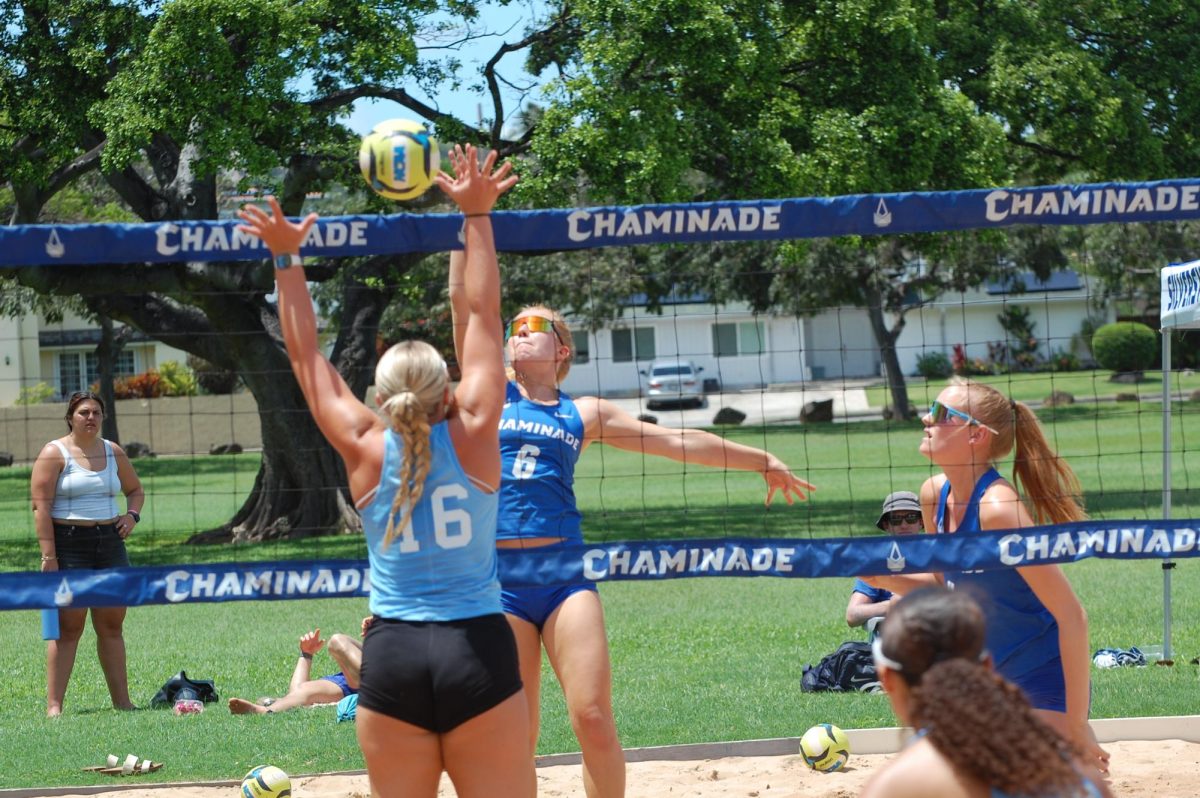
Of the 12 sports at Chaminade, volleyball has four of the six current international student-athletes. This season’s volleyball and beach volleyball teams included four international athletes: one from Poland, one from Argentina, and two from Germany.
The four international players make up 40% of Chaminade’s beach volleyball team, which just wrapped up its season last week. The Silverswords finished the season off with a win against Hawaii Pacific University for senior day. Chaminade’s German duo won the second flight to help the team secure the 4-1 win.
For 14 years as the head coach of the Chaminade volleyball team, Kahala Kabalis Hoke has brought in international athletes from around the world to be part of the team. Throughout the years, these players have helped the volleyball team become one of the best programs in Division II.
This year’s team featured Sina Bauer, the Silverswords starting libero from Germany, Beele Wieczorek, an outside hitter from Germany, Malena Mihalik, an outside hitter from Argentina, and Anna Karasinska, a middle blocker from Poland. As well, these players competed for the beach volleyball team against top Division I programs.
“For the most part, international players play one sport from a very young age and play it very competitively,” said Hoke, who is the program’s all-time winningest coach with 242 victories. “There are high-level leagues where the internationals compete with national-level players, so their IQ for the sport is usually very high.”
One of the biggest impacts from past international players was in the 2024 season when two players from Italy, Letizia Cammillucci and Anna Stucchi, were named to the American Volleyball Coaches Association (AVCA) Division II All-America Third Team. The Italian duo led the team to finish 8th in the final AVCA poll and a perfect 20-0 conference record. While for beach volleyball, the two co-led the team in wins with six.
This past 2025 season, the team’s internationals were young, with two sophomores and two freshmen. However, three of them still found at least eight starts each. Sophomore Mihalik and freshman Wieczorek were able to total up 11 kills together in the PacWest semi-finals for the indoor volleyball team. Bauer was named College Sports Communicators Academic All-District and PacWest Defender of the Week on Oct. 6. She also finished 10th in the PacWest in digs.

Before Bauer’s time at Chaminade, she competed at the national level and in the first and second divisions in Germany for Rote Raben Vilsbiburg. Hoke mentioned that the skills and IQ the international players learn before college are different from what Americans experience at the club level.
“I think the game here is more physical, with a strong emphasis on power and athleticism,” Bauer said. “Also, flying to games is a completely different experience compared to traveling by bus as I did in Germany, and it makes everything feel even more special and exciting.”
Moving over 7,000 miles away from home is hard, but a commitment that these foreign players decide to make when coming to Chaminade. The decision can be a mixture of both volleyball goals and personal life goals.
“I decided to come to the United States because I wanted the opportunity to compete at a high level in volleyball while also pursuing an academic degree,” said Bauer, who played in all 30 matches this year. “I was also excited to experience Hawaiian culture and see the beautiful nature of Hawaii.”
Since Hoke has been recruiting international athletes since she started coaching, she has grown contacts all over the world. She mentioned that the agents she has contacts with she trusts, so when she’s looking for a certain position or skill set, they can send her somebody who fills that need. This global connection gives the team a broader pick of individuals, and allows the Silverswords to find the best players that some other college programs can’t find.
The team as a whole is a melting pot of cultures with seven Hawaiians and seven mainland Americans to add to the internationals on the team.
“It’s really a great experience for all to work through the language barriers and cultural differences,” Hoke said. “For them to find the beauty in how we can connect through the game, and how we can connect through other similarities.”