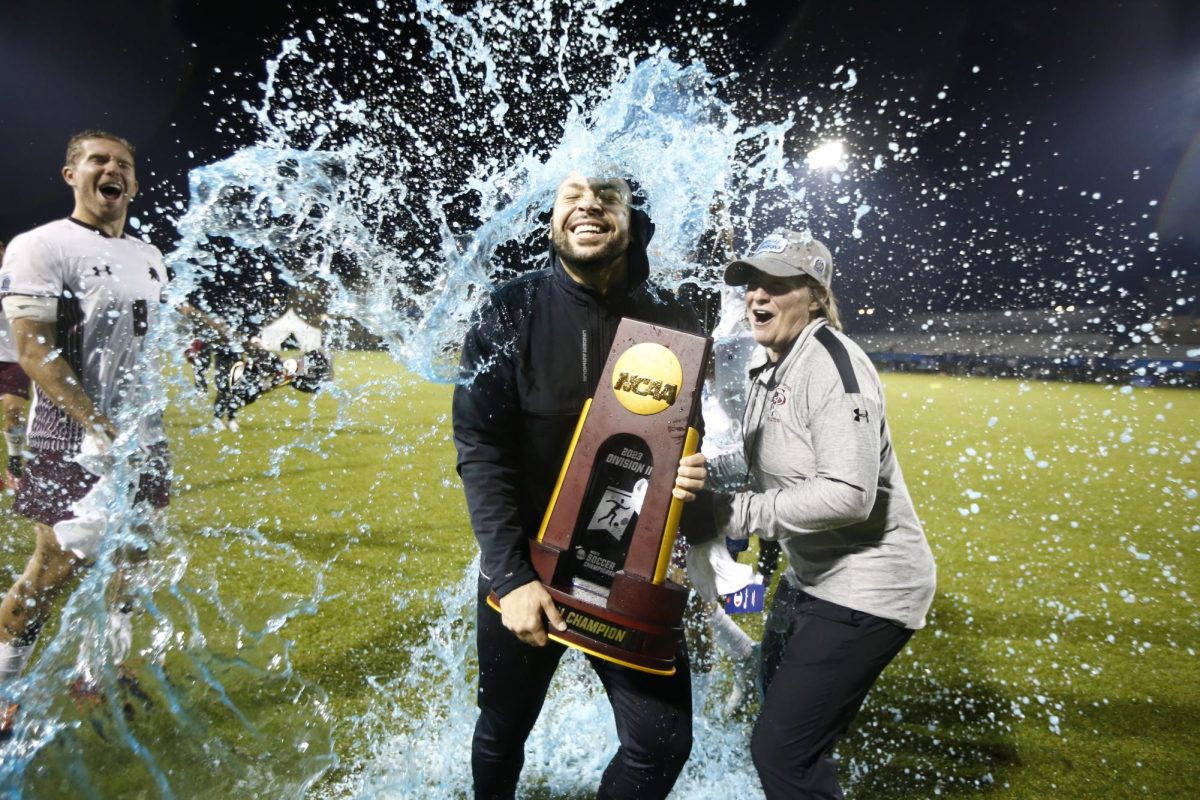
Travis Brent grew up in the American soccer system, playing in the U.S. Soccer Development Academy level (DA). He then went on to play college soccer at Marshall University, where he won all-conference honors. After college, he played about four years of professional soccer in Europe and America. Now, at 33 years old, he has coached his college teams to three national championship appearances in the last five years.
Brent’s successful coaching career started during his four years as the assistant coach of the University of Charleston, a Division II perennial powerhouse. During his four years, Charleston only lost six games and won the 2019 national championship. His success brought him to his current job at Franklin Pierce where in his first year as the head coach he led them to an undefeated season and the 2023 national championship.
In 2024, between the two highest levels of professional U.S. men’s soccer, the MLS and USL Championship, there were 19 Americans starting out of 44 players in both championship games. At the collegiate level between Division I and Division II there were only six Americans starting out of 44 players in both championships. However, four of the Americans were starters for Vermont University, and they won the Division I championship.
“I think when you play at the highest level it doesn’t matter what country that you’re from because the teams that are going to try to win will get the best players regardless of their origin,” Brent said. “At the end of the day, the best players are going to find a way to play.”
In Franklin Pierce’s 2023 national championship winning team, they had five Americans play, this is significantly higher than usual. In the 2024 national championship, the winner, Lynn University, only had one American play.
“We (Franklin Pierce) actually recruit a lot of good American players contrary to popular belief because I like American players,” Brent said. “They have a different type of mentality, they have a different type of fortitude and obviously most of the time they are some of the most athletic types of athletes in general.”
Brent sees American players as better athletes since the majority of kids in America grow up playing more than one sport. Brent emphasized that the technical gap between Americans and the rest of the world is shrinking. This is noticeable in the 12 American players who were in the 24-25 Champions League.
“The American player in my perspective and my opinion is for the most part a lot more coachable,” Brent said. “They have a willingness and a desire to please and succeed, so their work rate and how they approach trying to improve is a lot better than internationals.”
There’s lots of disagreement if men American players can match up against international players on the pitch. In October, FIFA ranked the U.S. men’s national team (USMNT) 16th in the world. For a team that failed to qualify for the 2018 World Cup, the USMNT has been improving like the rest of U.S. soccer.
The 2026 World Cup is the next big opportunity for the USMNT to show how much U.S. men’s soccer has grown. Even though the World Cup is being hosted by Mexico, United States, and Canada, 78 of the 104 matches will be held in the United States. This will give the world a first hand look at the popularity of soccer there. Soccer is generally seen as lagging behind American football and basketball as the most popular sport in America.
Hosting the World Cup is an opportunity for the sport to grow even more in America. The last time the U.S. hosted the Men’s World Cup was in 1994. At this time, soccer had barely any popularity in America. The sport has grown massively since then with over 14 million people participating in outdoor soccer, according to For Soccer.
However, the struggle for Americans to gain respect from internationals in the soccer world continues to be a problem.
The International Perspective
Not everybody agrees with how close American soccer is to the rest of the world. Lee Morris, an ex-Premier League player, and now South Carolina United Boys Elite Clubs National League (ECNL) and South Carolina United USL 2 Director has a different perspective than Brent.
“Unless they (U.S. colleges) were to put a certain amount of international cap so you can have 10 on your roster and the rest have to be Americans,” Morris said, “there’s just no real way of giving them (Americans) the opportunity. … If you want to win, you have to go and get the internationals. When the roster limits increase, if you don’t increase the amount of foreigners you take, you’re just going to get smashed.”
Morris grew up in the Sheffield United Academy in England, where he turned pro at 17 years old. Morris became the fourth most expensive teenager in British football history at the time, when he transferred to Derby County in 1999 for €3 million. He went on to play in the Premier League for Derby and Leicester City for a few years, while also making appearances for the England U18 and U21 teams.
After his playing career was over, he began coaching at Derby County’s academy, which was in the top academy league in England, and played teams like Liverpool and Manchester United. He then moved to America where he found his current job at South Carolina United and coached the SC United Bantams in the United Soccer League 2 (USL 2) for eight years. Over his 10 years at SC United, he has worked on building a program similar to the English academies he grew up in.
“When I left home at 16 and was at Sheffield United, that was my job. I was getting paid to do it and every day, I went in and played against fully grown men and I was the little guy and I got the shit kicked out of me and stuff like that,” Morris said. “It was just instilled to me day after day after day. ‘Listen, we can cut you at any time unless you give your role on the pitch every single day we can cut you,’ and there’s always gonna be somebody coming in that wants to take your spot so you’re just fighting for your life from 16 onward.”
The mentality of “do or die” from internationals is one of the main reasons Morris thinks they have an edge over Americans. SC United tries to build this mindset by letting young kids play up against the semi-pro level guys, but unless every American academy adopted this system, it’s a hard problem to fix.
“America’s on the right track with it, but obviously at the same time as we’re getting better the rest of the world doesn’t stand still, so it’s a tough one to catch up against the superpowers over there,” Morris said.
Why Internationals are More Technical
Most players and coaches agree that international players are more technical than American players. A huge reason for this is that soccer is simply way more popular in other countries.
According to Fox and Telemundo, in 2022, only about 16.5 million out of 333.3 million Americans watched the United States men’s national team play the knockout stage game against Netherlands in the World Cup. According to Association of Commercial Television in Europe, 42.9 million out of 210.3 million Brazilians watched their 2022 World Cup knockout match against Croatia.
This love for the sport in other countries brings kids into soccer at a young age. These kids play and watch soccer all the time, which gives them a lot of tactical knowledge without them even knowing. Mix that with great coaching at a young age, and you start to see the difference between an American and an international kid.
“You don’t have kids watching it as much or just going out on the street and playing soccer, which I think is huge,” said Union University head coach Steven Cox. “I’ve been on a few mission trips to Brazil a couple of times and Mexico a couple of times, and you just go out in the street and kids are playing soccer, and we obviously don’t have that in America.”
Cox, who is in his eighth year at Division II Union University, has seen the gap in technical ability between Americans and internationals firsthand. Cox is a Canadian native who played with the Canadian youth national team and before Union was the assistant coach at Division I schools, NC State University and Butler University. With his current team being 50% Americans, he sees the difference in technical abilities.
One of Cox’s players at Union was Stan De Vries, who played four years at Union where he was a standout player winning all-south region honors. He completed a fifth year at Division I Seton Hall University where they ranked as high as number eight in the nation. He is now playing professionally in Sweden for Vastra Frolunda IF.
“I think international players just have a better understanding of how to play the game compared to an American player,” Cox said. “They (foreign players) have a little bit more urgency to it or they have a little bit more of a professional approach. Obviously somebody like Stan had a really good understanding of the game.”
De Vries said he started playing soccer when he was 4 years old, and that sole focus on the one sport has given him an advantage.
“I feel like in America, you have the chance to try out every sport and see what you are best at,” he said. “But also, you are spending maybe one semester or one season like only in the fall you are focusing on soccer and the rest you’re not focusing on soccer. That’s why they stay behind as well.”
Ways to Fix the U.S. System
Like every system, the U.S. men’s soccer system from youth to pro is imperfect. People have different opinions on what is wrong with the system and ways to fix it, but the truth is there is no perfect fix that will make everybody happy.
However, many coaches and players agree that a promotion and relegation system for youth and professionals would be a great realistic fix. Also, changing the youth system from pay to play to a system that has free academies in every state would help a lot even though it’s less realistic. The promotion and relegation system moves teams between different divisions based on their season-end performance, where top teams move up and worst teams move down.
“It (promotion and relegation) gives the opportunity for kids in the second division clubs (in Spain) to be promoted to the first division to play teams like Barcelona and Real Madrid’s academies, while teams like Getaf’s academy in some age groups are in the second division,” said 21-year-old Michael Oelberger, a player who played the highest level of semi-pro in Spain. “So you can go up and down, and it’s what creates talent. And I think the pressure sucks, but pressure makes diamonds.”
Oelberger is an American who has experienced many different levels from playing in Spain to playing for Division I school Butler University. He explained how important promotion and relegation was in Spain and how it made him into a better player. Every game that was played meant something no matter what league or age you were.
In America, at the pro and youth level if a team is already out of playoff contention they have no true reason to keep giving maximum effort. Oelberger talks about how in Spain every game meant something, and there was no fading out of the season at the end. Oeleberger is just one of many American players who have played overseas or still are playing overseas who saw such success in the promotion and relegation system.
“Promotion and relegation system brings a lot more incentive and draws a lot more out of the players, we even have that here in Germany, U-19 Bundesliga,” said Micah Ham, an American in the fifth division of German soccer. “The first year I was there we (FC Ingolstadt 04 U19) barely survived; we were like two points away from being relegated. I definitely think that’s a big incentive and it definitely helps the players strive to be better.”
Ham, who is 19 years old, grew up in America and played at the highest level of youth soccer for Atlanta United’s academy. After being recruited to play in Germany in 2022, he said he prefers to stay there for the rest of his career. Not only does he find the promotion and relegation system more beneficial there, but he also feels more prepared for the professional level after playing at the highest academy level in Germany.
“I just think the U.S. soccer system doesn’t do a good job developing players like foreigners do, so the foreigners are usually a lot better,” said American Terry Watson, a center-back at Gonzaga University. “How expensive it is to play soccer at a high-level kind of hinders the best talent coming through, like the most athletic guys that could have developed to be great soccer players instead choose a different sport because it’s a lot cheaper.”
Watson, an ECNL All-Conference player and Division I national championship winner with Clemson University, brought up the problems of America’s pay-to-play model. If soccer wasn’t so expensive to play at the highest youth level, more kids would be able to compete, and the players who can afford it would have more pressure to perform. This pressure gives the players the “do or die” attitude that separates Americans from internationals.
SoccerAmerica estimates that to play at the ECNL level it costs about $8,000 a year. It’s hard to bring this price down because America doesn’t earn a lot of money off soccer compared to football and other big sports. For example, the highest salary for a player in the MLB is $70 million, in the NBA is $55.7 million, in the NFL is $53 million, and in the MLS is $20.4 million. Therefore it’s hard for America to just magically fix the pay-to-play model.
American Soccer Has Huge Positives
Despite the issues with the American soccer system, it still has many positives. The opportunity to play soccer at a high level while still getting a college degree is a benefit in the system.
“There’s a huge upside to it (the American system) and the reason why so many internationals come over to America is because we don’t get an education,” Morris said. “I left high school at 16 and that was me done. I haven’t picked up another book in my life and if I hadn’t made it professionally, I would’ve been released at 21 or 22 years old with no education and nowhere to go and I would’ve been behind in life, so there’s major upside to what America does compared to the rest of the world.”
The reality of the professional world is that only 1% of kids playing soccer will make it professionally. College soccer is a way for America to produce professional players but also to keep the ones that don’t make it professional from falling behind in life.
American players are also seen as the best players physicality-wise. Due to playing several sports at a young age, and the soccer style in America being all about physicality. The American players that make it to a high level, stand out from the rest because of their physical attributes like speed and strength.
“The big thing was my speed, and that’s one of the main reasons I got scouted because I ran track,” Ham said. “And I don’t think I would’ve had that opportunity in Germany.”
Even the rest of the world notices that Americans can be helpful at the pro level.
“I think it could be closer than they think as well, like most Americans have other attributes that help out a lot,” De Vries said.
Without a doubt, men’s American soccer is growing and getting better year by year. In the 2014 World Cup, the USMNT had five starters playing in the MLS. According to the MLS, in 2014, the league was ranked 12th in the world. In the 2022 World Cup, only one starter for the USMNT was playing in the MLS, while the other 10 players were all playing in the top five leagues in the world.
The growth of American players playing in the big European leagues over the MLS is a huge positive that will excite more players in America to try to reach the same level.
“We have to ultimately identify with who we are and what makes us, us. We are a physical country and we produce amazing athletes,” said Brent, who took Franklin Pierce to the 2023 national championship. “ How can we continue to maximize our athletic advantage to better equip our national team and our club?”