
On a busy Tuesday afternoon, while many students are rushing between classes and deadlines come sooner than expected, a quiet gathering takes place inside Chaminade’s Counseling Center, located in Tredtin Hall. At 1:30 p.m., journals open, pens and markers start hitting the paper, soft music plays, and every person at Chaminade — students, faculty, and staff — is invited to slow down to check in with themselves.
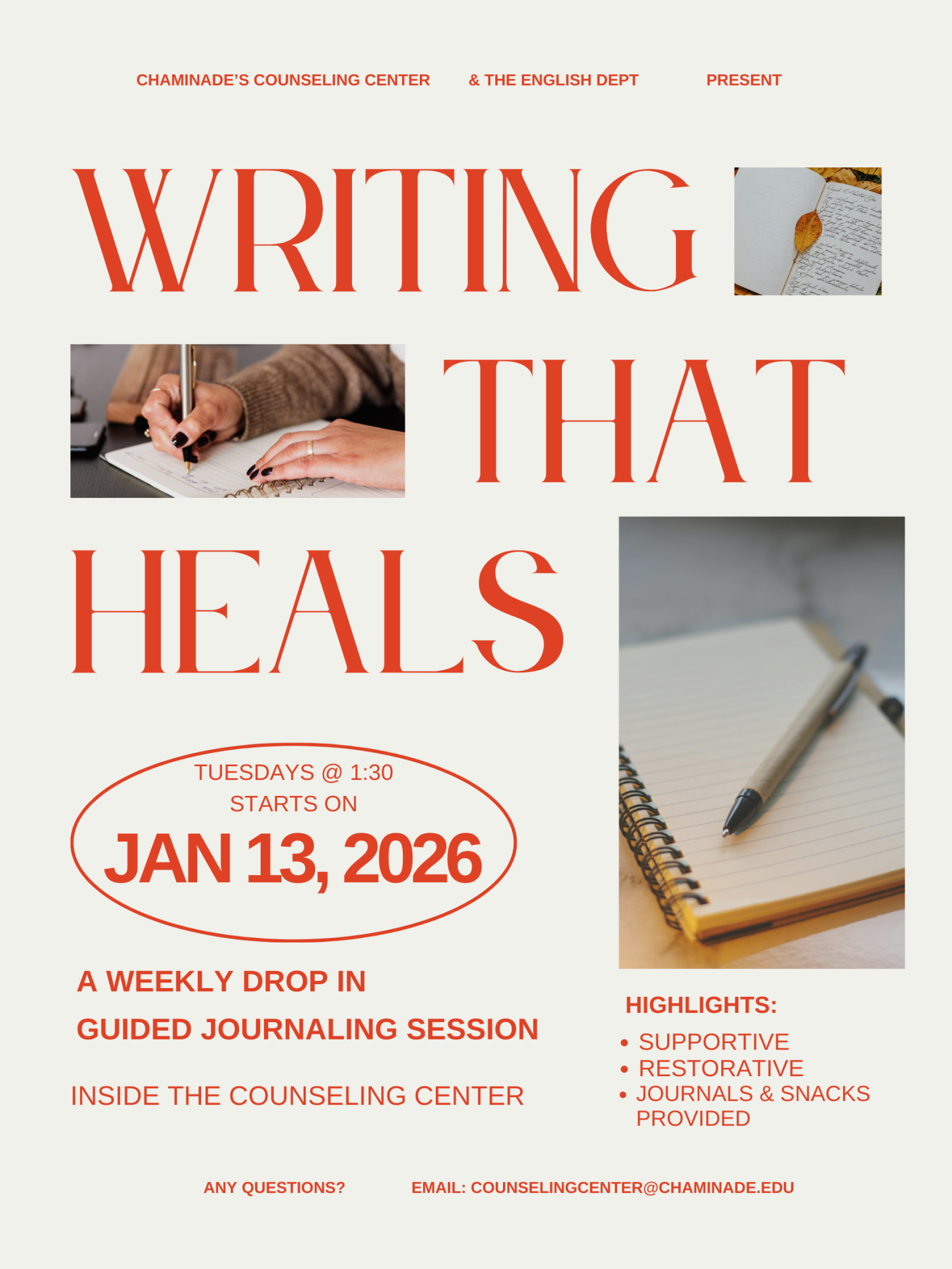
Writing That Heals is a weekly drop-in journaling session hosted by Chaminade’s Counseling Center in collaboration with the English Department. Held every Tuesday at 1:30 p.m. during the Spring 2026 semester, participants are offered a structured but low-pressure space to reflect on their academic and personal lives.
“It’s a guided journaling space where students can pause, reflect, and check in with where they are, academically, personally, and emotionally,” said Melissa Rutigliano, a clinical intern at the Counseling Center. “Sometimes we get so overwhelmed that we forget to stop and ask ourselves where we actually are.”
Unlike one-time wellness workshops, Writing That Heals is designed as an ongoing experience students can return to throughout the semester.
Writing That Heals started from James Kraus, a professor of English at Chaminade, at Halawa Correctional Facility through Chaminade’s Prison Education Program. Rutigliano, who used to work under the English department, wanted to bring this program to the whole Chaminade campus.
So far, after originally beginning at Chaminade in September 2025, there have been about 13 sessions of Writing That Heals and about three to seven people that participate on any given week.
Each session begins with simple prompts meant to ground participants in the present moment. Questions such as “Where am I right now?” and “Where do I want to be?” guide students into writing freely. Music plays softly as participants journal together, creating a calm and welcoming environment.
“We start with simple questions, and then we just write,” said Rutigliano, who is also a Master of Science in Counseling Psychology student set to graduate this May. “There’s no pressure to share unless you want to. It’s meant to be a safe space where students don’t have to put on a face and can just be themselves.”
Elisabeth Mather, one of Chaminade’s licensed counselors, highlighted the mental and emotional benefits of journaling. She noted that taking time to reflect and put thoughts into words can be especially helpful for students.
A key focus of the sessions is encouraging participants to identify and name their emotions, a process that can help reduce stress and increase emotional awareness.
The sessions also explore the concept of “meta-emotions,” or how individuals feel about their emotions.
“We all experience a range of emotions,” Mather said. “Identifying what we’re feeling and how we respond to those emotions is something students really benefit from.”
Although the sessions take place in the Counseling Center, facilitators clarify Writing That Heals as an opportunity for self-care and self-reflection and not a therapy group. Mather also noted that journaling can serve as a gentle entry point for those who may feel hesitant about seeking mental health support.
Both Rutigliano and Mather have noticed that a sense of community gets built over time, sharing that at the end of each session, participants contribute a single line from their writing to create a collaborative poem.
“There’s something powerful about creating something altogether,” Rutigliano said.
Beyond reflection, the Counseling Center’s hope is that all participants leave with a clearer sense of direction.
“We don’t just talk about goals,” Rutigliano said. “We name the roadblocks and ask how we can move around them instead of getting stuck.”
Writing That Heals sessions are free and open to everybody: students, faculty, and staff alike.
For more information or have any questions, email [email protected].
“Just come,” Rutigliano said. “There are free snacks and no expectations.”