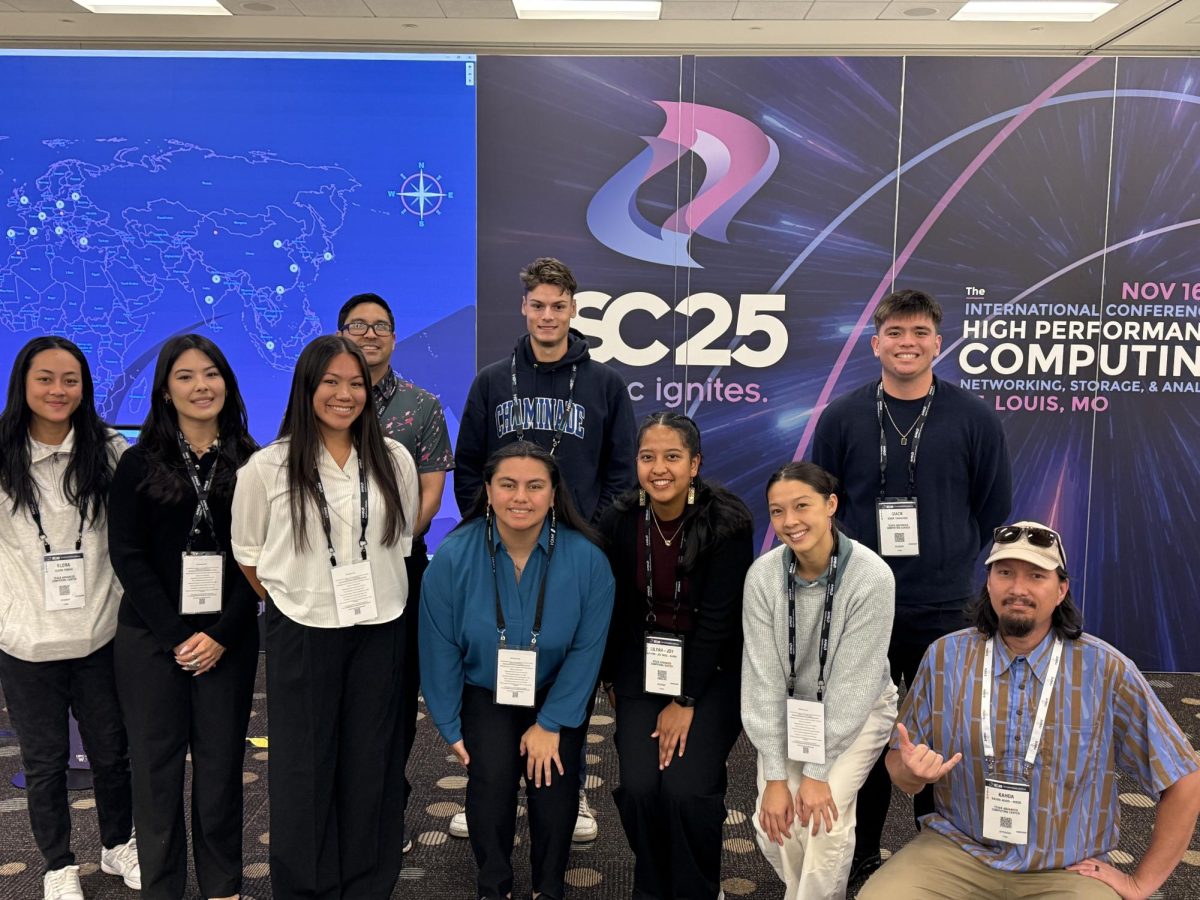
While most students were preparing for Thanksgiving, seven Chaminade Computer and Data Science majors were headed to St. Louis, Missouri, for a fast-paced academic experience designed to boost their college careers.
Chosen from more than 500 applicants nationwide, the group earned a spot among 24 students in the Advanced Computing Student Collaborative (ACSC) internship, run by the Texas Advanced Computing Center (TACC), from Nov. 15-21.
In just five days, students had to select a problem, build a full research project, run analyses on TACC’s supercomputers, and prepare a presentation for the Supercomputing Conference. The tight schedule pushed them into an intense crash course in advanced computing, teamwork, and scientific problem-solving.
“This program doesn’t just teach technical skills; it gives you the graduate student experience by immersing you in a real research workflow,” said Chaminade mentor, Liliyah Quel-Kaina, who attended ACSC as a participant last academic year and provided hands-on guidance to this year’s interns. “I saw so much growth in their ability to scrub datasets from websites, develop machine learning models using advanced parallelization, and build their own calculation system.”
The ACSC internship emphasizes learning, giving students the opportunity to work with cutting-edge computational tools that are typically reserved for graduate students or industry professionals. By pairing participants with mentors and providing access to TACC’s supercomputing resources, the program allows undergraduates to explore complex datasets, develop machine learning models, and engage in high-level problem solving in a condensed timeframe.
Fourth-year computer science major Larchelle Tuifao focused her project on detecting early-stage pancreatic cancer using convolutional neural networks and risk factor data. She chose this topic based on the fact that she had family members diagnosed with pancreatic cancer later in life.
“I worked with the data of 416 subjects, ages 18 to 96, and 436 MRI sessions of both healthy individuals and individuals with signs of dementia,” Tuifao said. “I also investigated whether traditional machine-learning models could detect cancer based on patient-reported symptoms and risk factors, which tested both me and the computer.”
ACSC immerses undergraduates in high-performance computing, data analysis, and AI while applying computational skills to real-world societal challenges.
Beyond technical skills, the program also emphasizes professional development. Participants practiced communicating complex results to non-technical audiences, collaborating effectively within interdisciplinary teams, and managing tight project deadlines — skills that are critical for careers in research, technology, and data science.
“You have to have a strong mindset and not give up when things get tough,” Tuifao said. “If a chunk of code isn’t working, I have to find a new way to get the same outcome and use the people and resources around me.”
This program is built to not only prepare these participants for their future career goals but teach them how to engage in using advanced computing techniques and technology to interpret data while gaining the confidence to do so.
The trip gave them a glimpse of real-world research, strengthened their confidence, and reinforced the importance of perseverance and collaboration. For participants like Tuifao, the internship was more than an academic challenge, it was an opportunity to apply technology to meaningful societal problems and to see firsthand the difference their skills can make.
“I hope they all continue taking a chance not only in other internships like this one, but also in themselves and their abilities, going out into the workforce to learn and develop these skills they learned even more knowing they are capable,” Quel-Kaina said.