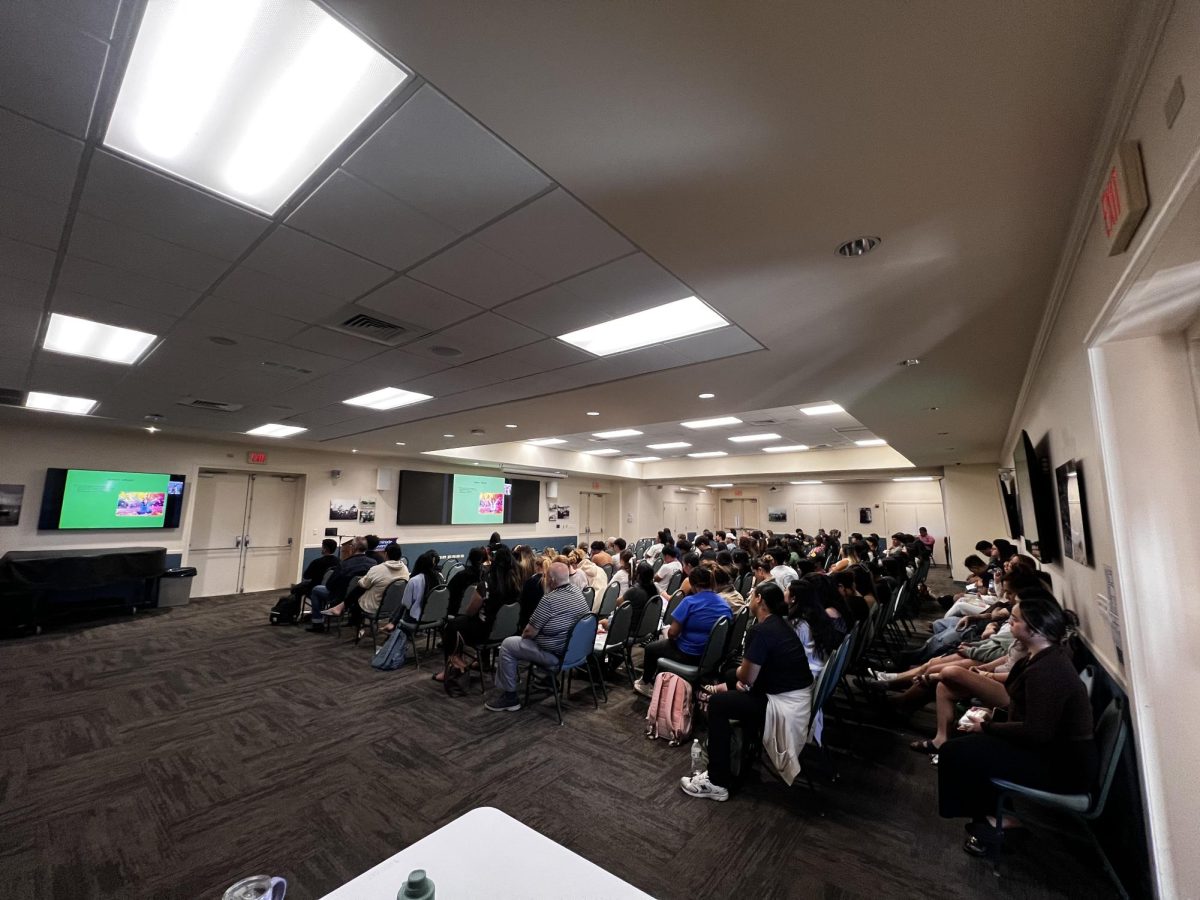
On Monday afternoon, conversations in the Clarence T. C. Ching Conference Center came to a stop as a Zoom window lit up the projector screen. Dave Augeri, a conservation biologist who has spent decades studying and protecting species worldwide, appeared with a calm smile, ready to speak about the challenges facing the planet and the choices that shape its future.
Augeri’s presentation, titled “When Are We Going to Do Something?: On Human Agency and the Future,” urged students to confront climate change and biodiversity loss.
Before he began, Gail Grabowsky, dean of Chaminade’s School of Natural Science and Mathematics, introduced him as a conservation biologist with global experience. She highlighted his two doctorates, one in wildlife ecology, biodiversity, and conservation from the University of Cambridge and another in island biogeography, along with his research on species such as elephants, gorillas, jaguars, and polar bears.
His talk was one of the guest presentations scheduled for CUH 100 this semester. Earlier speakers discussed leadership, responsibility, and the factors that influence people’s everyday choices. The purpose of the series is to help students see how the concepts covered in class translate into real-world work and decision-making.
From the start, Augeri said that environmental issues are no longer problems for scientists alone. They affect daily life, from the food people eat to the weather they experience. He explained that wildlife populations worldwide have declined by about 73 percent since 1977 and that species are disappearing much faster than in the past.
“If that does not wake people up about the climate crisis, I do not know what can,” Augeri said.
Despite the difficult statistics, Augeri said change begins with how people think and how they choose to act each day. He noted that anyone, in any field, can make a difference by understanding the influence they have in their own communities.
“One thing that stuck with me is that we each need to commit to change, whether it is small or big,” said Pete Steiger, associate professor of Religious Studies in the School of Humanities, Arts and Design at Chaminade, who attended the event. “The situation your generation [Gen-Z] will inherit is complicated. As faculty, we are committed to helping students prepare to embrace those challenges.”
Justin Wyble, who teaches CUH 100 and serves as an assistant professor of English at Chaminade, said the event fit naturally within the university’s mission-centered approach.
“The title itself asks a simple question,” Wyble said. “When are we going to do something? The message encourages students to think about their role in addressing environmental challenges and to understand that their actions, even small ones, can contribute to meaningful change.”
Throughout the presentation, Augeri asked students to think critically and not rely on unverified information. He told them to question assumptions, verify sources, and remain willing to learn. He said the world does not improve through silence or indifference, but through thoughtful decisions that reflect respect for people and the planet.
“When we change our values, we change our behavior,” Augeri said. “And behavior is what changes the world.”
As the Zoom session concluded, Augeri emphasized that individuals influence the direction of the world through their choices. He closed by reminding students that environmental progress often begins with awareness and a willingness to act with intention.
The presentation closed the CUH 100 session for the day, with a reminder that environmental challenges connect back to the decisions people make in their everyday lives.