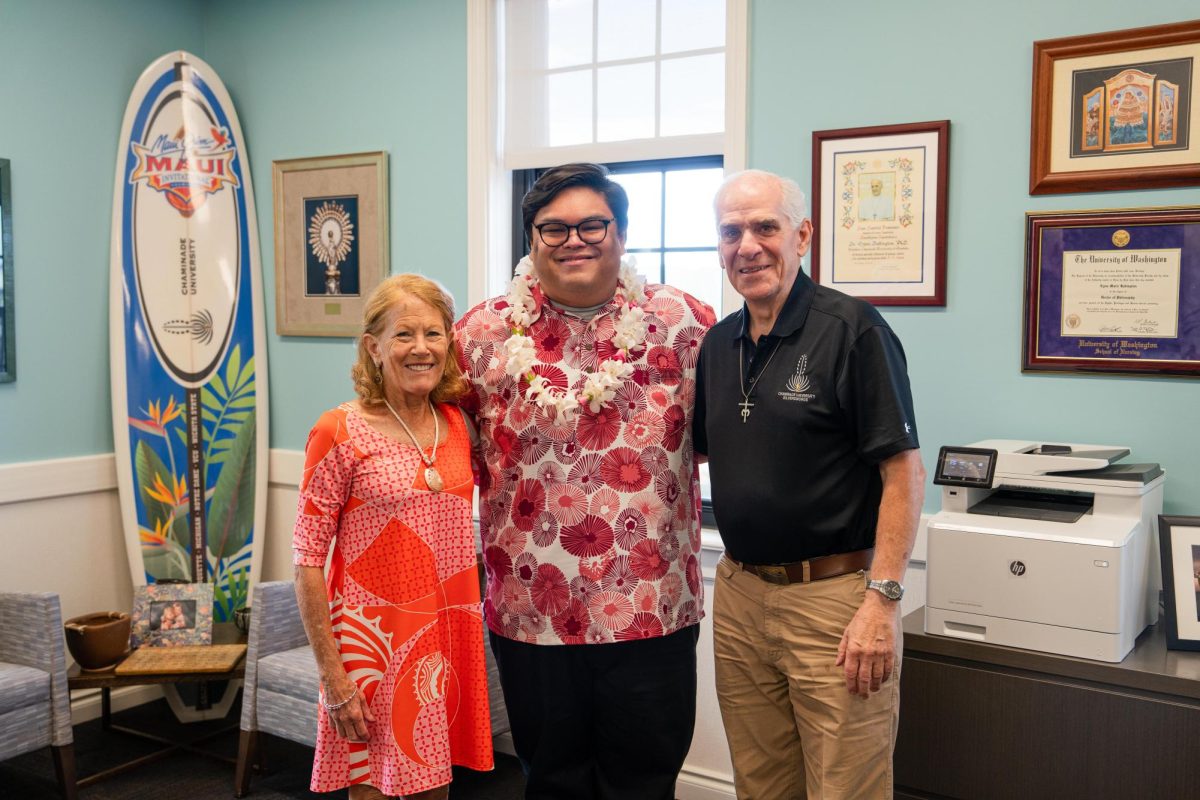
At Chaminade University, teaching goes beyond pointing students in the right direction. Sometimes, it means walking alongside them, listening to their stories, and helping them see possibilities they never realized were within reach.
That philosophy defines the work of Dustyn Ragasa, Ph.D., a religion professor and the recipient of the 2026 Chaminade Award. The award honors a faculty or senior leadership member who demonstrates the Characteristics of Marianist Universities through a sustained commitment to faith, service, justice, and the dignity of all people.
“I could just point someone in the right direction, but it’s more meaningful and personable to walk with them,” Ragasa said. “That’s a Chaminade difference.”
Ragasa and the other Heritage winners, Abigail Hurgo, assistant vice president for Enrollment Management and recipient of the Marianist Award, and Easton DelaCruz, fourth-year Communication student and recipient of the Founders Award, will be honored today, at 11:30 a.m. inside the Mystical Rose Oratory.
Ragasa, who is also the director of the Master of Pastoral Theology program, sees education as something deeply personal. A first-generation college student and former high school dropout, he earned his GED certificate before attending college. He completed his undergraduate degree in Religious Studies at Chaminade in 2007 and later earned his master’s and doctorate in Ethics from the University of California, Berkeley. He knows firsthand how unfamiliar higher education can feel to those encountering it for the first time.
Ragasa returned in 2019 to begin his career as a professor.
“There’s always possibilities beyond what a student thinks they’re capable of doing,” said Ragasa who is 38 years old. “Part of my role as a person and professor is helping them look beyond those self-imposed limitations.”
Although his academic journey was nontraditional, it continues to shape how he supports students navigating college life.
“People don’t know what they don’t know,” Ragasa said. “I never understood what it meant to write a paper or read a book when I first started college.”
That perspective influences how he builds relationships with students, often beginning before his class formally starts.
Cheryl Edelson, the dean of the School of Humanities, Arts, and Design, noted the meaningful impact Ragasa has on the Chaminade campus.
“He’s the kind of faculty member who is always present,” Edelson said. “You can feel he is coming from a sincere and authentic place, one rooted in optimism, hope, and possibility. Everything he does, from teaching to research to service, is woven with the Marianist education characteristics.”
Justin Wyble, a professor of English and colleague of Ragasa, shared the same sentiment as Edelson. He described Ragasa as “friendly and personable” with a way of immediately putting people he meets at ease.
“That approach often leads to conversations deeper than expected,” Wyble said. “He’s as much a life advisor as he is a professor.”
With his background and expertise in ethics, Ragasa’s teaching is guided by a belief that education should serve the common good.
“The whole point of ethics is to help create a more just society,” Ragasa said. “To help everyone level up together.”
For Ragasa, living out the Marianist mission means accompaniment rather than distance.
At the heart of his work is a commitment to supporting students in every step of their journey. That commitment, to students, justice, and a faith-rooted education, is what the Chaminade Award recognizes.
“I’m employed by Chaminade, but I work for the students,” Ragasa said. “Every day that I’m here, I try to be better for them.”